
Introduction
The VV methodology incorporates ship specifications, real time sales and market sentiment which enables market valuations of vessels in even the most illiquid markets. The model is continually updated and recalibrated overnight to give the closest fit possible to reported sales.
The below variables are applied when valuing Cruise ships.
Ship Type
Cruise ships in VV are categorized into 3 main types by size:
-
Mega GT is greater than or equal to 175,000
-
Large GT is between 50,001 and 174,999
-
Small GT is smaller than or equal to 50,000
These size groups are split into sub types which include the following:
-
Standard have no distinct features and warrant no premium
-
Expedition have ice class and operate in expedition areas around the world. This sub type of Cruise receives a premium
-
Luxury have a passenger space ratio greater than or equal to 50. This sub type of Cruise
receives a premium -
Expedition Luxury meet both criteria for Luxury and Expedition Cruises. This sub type of
Cruise receives the highest premium.
Size
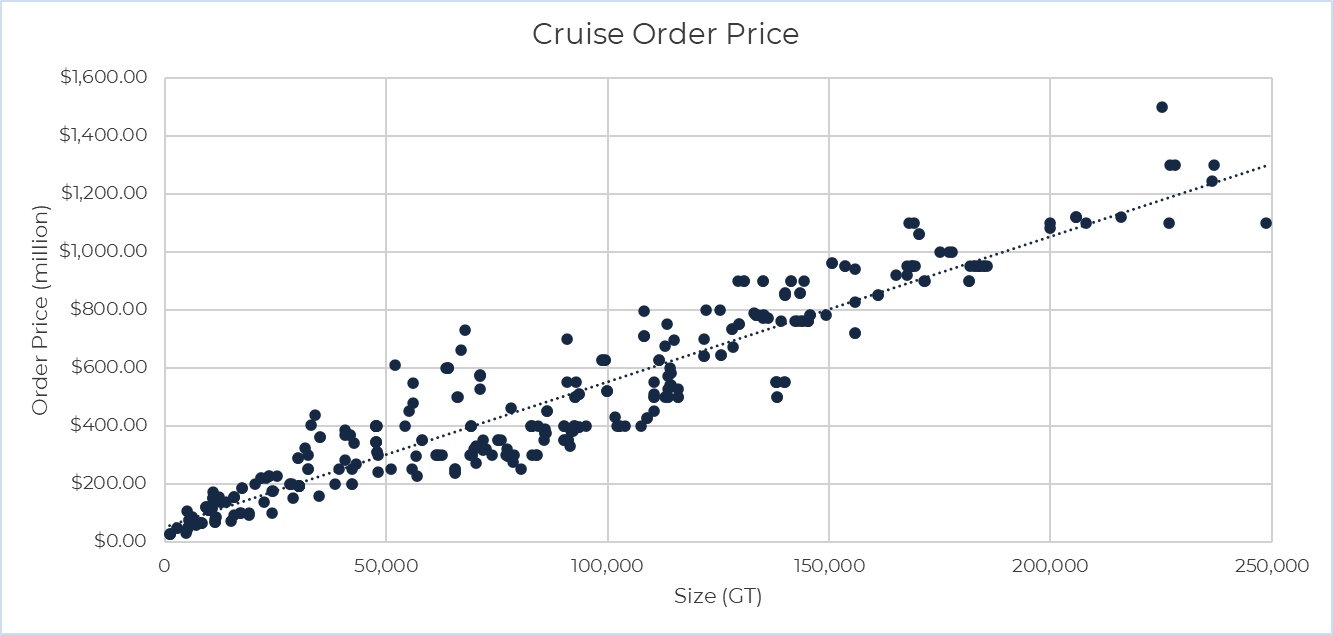
All Cruise ships use Gross Tonnage (GT) as their valuation size. This was found to have the strongest
correlation with value. The below scatter plot shows the relation between Order Price (USD mil) and
Size (GT). The size premium and discounts are calculated daily by the VV algorithms.
Age
Cruise ships can operate in excess of 40 years.
The vessels age depreciation profile is calculated daily by the VV algorithms and is not simply a matter of straight line depreciation. The depreciation profile depends on market conditions.
State of the Market
The most applicable market indicator for Cruise ships is Cruise Activity. This is derived from VV’s own AIS intelligence, dating back to 2011. Through this ‘live’ data we are able to measure and quantify inactivity on both a vessel and fleet level and factor this into our proprietary algorithms so that in the absence of market transactions, the VV values are constantly changing in line with the market.
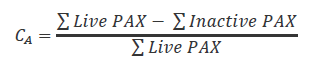
Cruise activity (CA) is calculated from the following formula. Where PAX is the number of passengers a Cruise ship can carry.
Features
Builder
As with Cargo and Offshore sectors, the builder is a significant variable to value. The builder premiums and discounts are different depending on the sector. For example, the discount given to a Capesize Bulker will be different to the discount given to a Cruise ship, built at the same yard.
These yard premiums and discounts are derived from both the newbuilding and second-hand transaction data and from this, analysis is conducted. In the absence of transactions, yard group analysis and the number of Cruise ships built at a specific yard are taken into account.
Class Society
Small discounts are given for lower regarded classes (i.e. non IACS).
Engines
The type of engine installed in a Cruise ship will determine the premium or discount to be applied. Below are some engine examples which receive premiums based on their type.
-
Eco engine
-
Diesel electric hybrid
-
Dual fuel
Another engine aspect which is considered, is the number of engines the Cruise ship has. For example, a Mega Cruise ship with 6 engines warrants a premium over Mega Cruise with only 3 engines.
Ice Class
Cruise ships with an Ice class receive a premium in the VV system. The amount of premium given to an ice classed Cruise ship depends on the type of ice class the vessel is installed with. Some common types within the Cruise sector are listed below. These all receive premiums.
-
FS Ice Class 1C
-
FS Ice Class 1A
-
IACS Polar PC6
Ice class is more commonly found on Expedition and Expedition Luxury Cruise ships.
Unique Features
Cruise ships are highly complex assets and VV takes into consideration several other Cruise specific features to be factored into the algorithms. These include but are not limited to:
-
Passenger space ratio (=𝐺𝑇𝑃𝐴𝑋)
-
Total number of decks
-
Accommodation
The complete list can be viewed under the Vessel Details tab under any Cruise ship.