
Introduction
You can create Carbon Allowance Transfer Journals automatically using available inventory and open invoices. You can choose from three price calculation methods to determine the transfer price, so you do not need to create transfer journals one by one.
Step 1 — Grant Security Access
The Financials module includes a security access control. A system administrator must grant users the right to access this feature by selecting Carbon Allowance Period Transfers.

After access is granted, the menu option is available under Financials → Period Closing → Carbon Allowance Period Transfers. Select it to open the Carbon Allowance Period Transfers form.

Step 2 — Complete the form and Create Journals
Complete the Carbon Allowance Period Transfers form using the following steps.

-
Select the Date. This is the transfer date for all of the allowances. Invoices dated earlier than this date are shown in the Outstanding Allowance Invoices section. Notes:
-
Outstanding allowance invoices are posted invoices. Invoices that are not posted are not eligible for transfer journals. In the example, only TEST155 is eligible.
-
Allowance invoices that have been fully transferred do not appear in the Outstanding Allowance Invoices list. Only invoices with a remaining outstanding balance appear.
-
Leave the Allowance ID column blank so that the system can allocate the allowance automatically. If you select an allowance ID at this stage, the invoice is not covered by the automatic journal posting.
-

-
Choose a Strategy and Company to filter the allowances by specific strategies or company setups in IMOS. Carbon allowances that match your criteria appear in the Available Allowances section, and only those allowances are used in allocation. If you have no particular criteria, leave these fields blank. All available allowances are then shown and used.
-
Select a Trade Area. Assign the trade to a defined region so that you can group and report on it alongside your other voyages, trades, and contracts.
-
Choose a Price Calc. Method from the following options:
-
WAC (Weighted Average Cost): prices the entire transfer using the weighted average cost of the full available inventory pool, regardless of which specific allowances are allocated.
-
Example: For a 300 MT transfer using FIFO, the Pool WAC is $73,000 / 1000 = $73.00/MT.

-
-
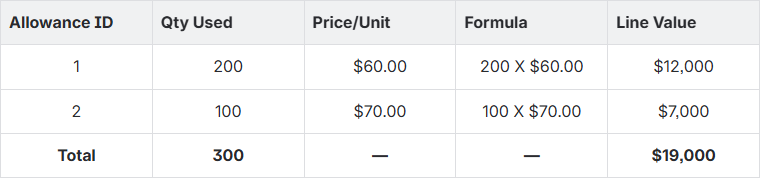
b. Allowance Price: prices the transfer using the actual purchase price of the specific allowances pulled from inventory (through FIFO or LIFO allocation), applied line by line for each lot.
-
-
-
Example: For a 300 MT transfer using FIFO, the value of each lot used (Line Value) is calculated as Qty Used × the lot’s own price.
-
No averaging is applied. Each lot keeps its original price.
-
-
-
-
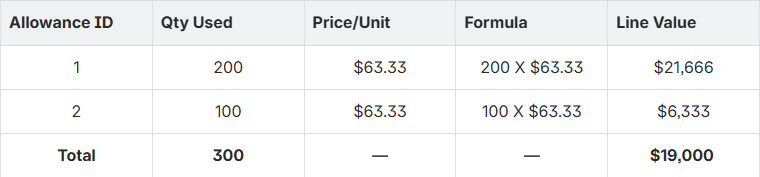
WAC of Selected Allowances: prices the transfer using the weighted average of only the lots actually used in that transfer, blended into a single rate. This is narrower than WAC, but not itemized like Allowance Price.
-
Example: For a 300 MT transfer using FIFO, Selected WAC = (200/300 × $60) + (100/300 × $70) = $63.33/MT. The total is 300 MT × $63.33/MT = $18,999 (rounded to $19,000).
-
-
-
-
Choose an Inventory Calc Method, either first in, first out (FIFO) or last in, first out (LIFO). The system allocates allowances according to your choice.
-
Select Calculate. The allowance transfer details appear at the bottom of the form with the allowance ID. The system allocates the allowance according to your choice of FIFO or LIFO. In the example, FIFO is selected, so the first allowance, 24939, is used in the transfer.
-
Select Create Journals. The system creates and posts the transfer journals automatically. The Allowance Invoices section is then empty.
Step 3 — Verify that the journal is posted successfully
-
Check the invoice status. In this example, the status of invoice TEST155 changes from Posted to Transferred, and the invoice appears under the Allowance Transfers section, as shown in the following image.

-
Check the Carbon Allowance Trade. In this example, 100 MT are transferred out.
