
🔑 This is a Key Topic, with high value for all users.
The Hire Statement for a Time Charter Out lists all invoiced and received amounts, and you can issue a bill directly from it. For a line item to appear in the Received section, create a Payment or Receipt must be created in the Financial Invoice of the TC Out Bill. You can also view related reports from this form.
To view the TC Out Hire Statement, do one of the following:
-
Click

-
On the Operations menu …, under Time Charter Out, click Hire Statement.
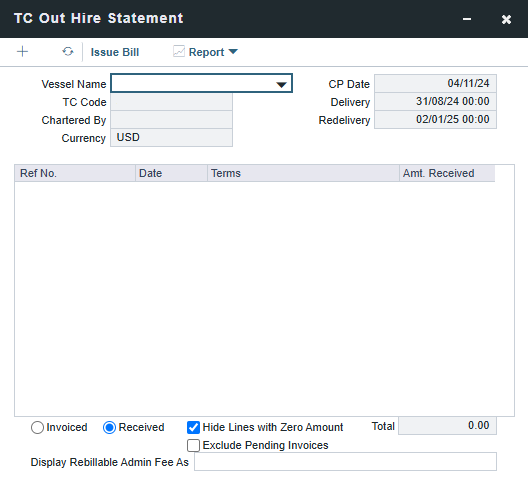
If there are bunker adjustment lines due to offhire, the offhire time period information is included in those lines.
Before creating a TC payment, enter bunker prices to ensure accurate calculation of bunker-related costs and offhire bunkers.
For offhire calculations, if no price is specified in the Delays form and the Bunkers tab within the Time Charter contract, the offhire bunker line is not displayed. When bunker prices are provided in the Delays tab, those values are used to determine the offhire bunker.
On a Time Charter Out Hire Statement:
-
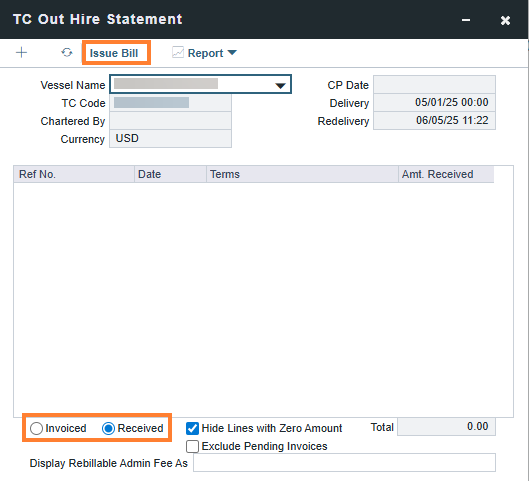
To select Invoiced or Received items, click the radio button at the bottom.
-
To issue a bill, click Issue Bill.
Reports
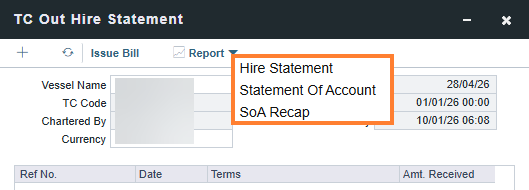
To view a report, click 
-
Hire Statement: Includes all the details of the contract so far: Gross Hire, Hire Commissions, Bunker Values, Owner's Expenses, Other Adjustments, and Payments. It also lists any inconsistent items. At the end of the contract, an owner can send the charterer the Hire Statement showing the balance.
-
On a Hire Statement Report for bunker costs, the text refers to the entities as Charterer and Owner.
-
Configuration flag CFGTcItemsFlag enables you to print out, as both Outstanding Items and Inconsistent Items, certain TC items, including Rebill, ILOHC, and INTHC.
-
-
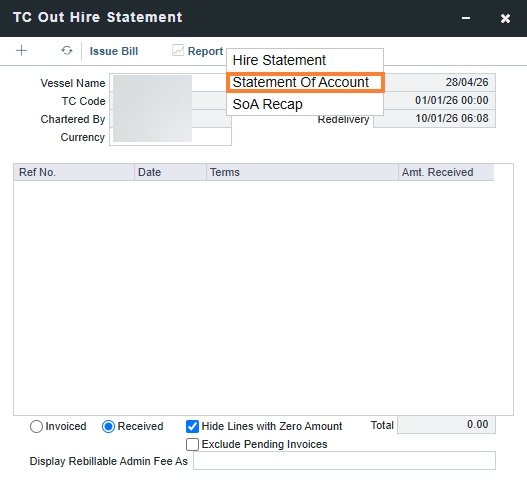
Statement of Account: Use this report to determine whether any outstanding amounts remain to be paid or received over a defined billing period for a Time Charter (TC) that has already been invoiced.
Key Characteristics
-
The reporting period is defined from the From Date of the first hire or bill to the To Date of the last hire or bill.
-
The system calculates the net amount due to or from the Owner/Charterer based on the TC In/Out fixture terms, then deducts any amounts already invoiced, paid, or received.
-
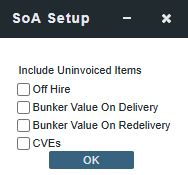
When you run the report, the SoA Setup form allows you to optionally include uninvoiced items for visibility.
-
Offhire value is derived from the TC contract.
-
Delivery or Redelivery bunker values are pulled directly from the TC contract.
-
The CVEs (victualling period) is based on the Projected or Actual GMT fields on the TC contract.
The Proj or Act GMT field on the TC Out contract must be populated before running the Hire Statement or Statement of Account. If this field is blank, the Hire Statement and SoA will calculate an incorrect number of hire days. The SoA Recap is not affected, as it uses the contract Start Date.
-
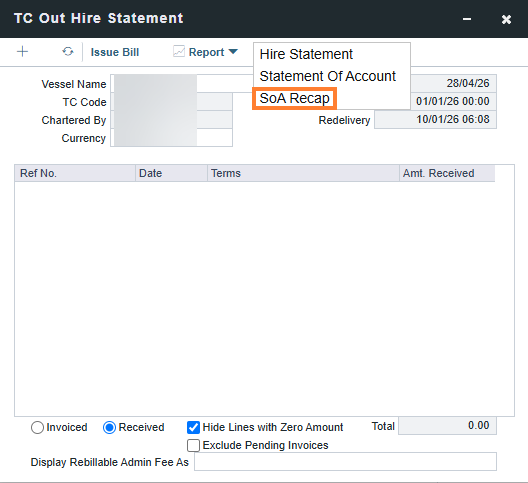
SoA Recap: Provides a comprehensive summary of all invoiced items under a Time Charter (TC) contract, including those in both Posted and Pending status. It categorizes and displays the invoice data for clear reconciliation and tracking.
Key Characteristics
-
Displays a detailed breakdown of all posted and pending invoices within the contract.
-
Uses the Start Date from the TC contract and the latest Period To date from the hire invoices to define the reporting range.
-
In Hire invoice, the recap reflects the actual billed days (for example, an invoice covering 27 days will include all 27 days in the recap).
-
-
The balance shown is calculated based on the Estimated Expenses configured in the TC contract. The SoA Recap provides a snapshot of invoiced activity and is a valuable tool for reconciling projected versus actual expenses.
If discrepancies arise between the Statement of Account (SoA) and the SoA Recap, they are often due to differences in how bunker values are sourced (contract vs. invoice) or variations in date logic.