
Home > Financials > Account Analysis
Accounts Analysis Report
The Accounts Analysis Report is a built-in Financials report formatted by Veson Nautical. It is only available if your company posts IMOS invoices to the financial ledger — if you do not post transactions, this report is not usable. Need something more flexible? Use the Report Designer to build a custom report instead.
What it Shows
The report summarizes financial transactions for a specified range of accounts and dates, with optional filters for vessel, voyage, and vendor name. For each account, it displays:
-
The starting balance on the selected start date
-
Each transaction's debit, credit, and running balance
-
Retained earnings carried forward
You can group transactions by account, vessel, or vendor.
For example: If an account starts the period with a balance of $10,000, and a $2,000 debit transaction is posted, the running balance updates to $12,000. The next transaction — say, a $500 credit — brings the running balance to $11,500, and so on through the date range.
Accounting Convention
Because this report is a view into the General Ledger, balances follow standard accounting sign conventions. Accounts increase as follows:
|
Account Type |
Increases With |
|---|---|
|
Assets |
+ (debit) |
|
Liabilities |
− (credit) |
|
Revenues |
− (credit) |
|
Expenses |
+ (debit) |
So in the example above, a debit increasing the balance tells you this is likely an Asset or Expense account; if it were a Liability or Revenue account, that same debit instead decreases the running balance.
Report Options
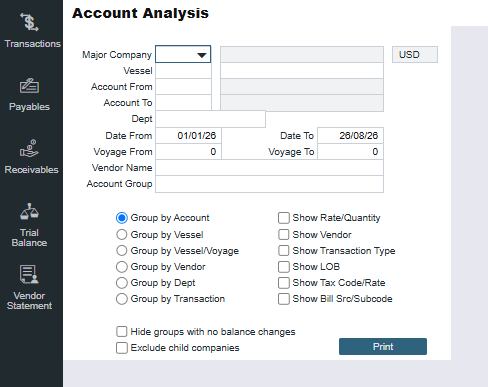
|
Field Name |
Mandatory / Optional |
Description |
Use When? |
|---|---|---|---|
|
Major Company |
Mandatory |
A Type W company from the Address Book; this field determines which transactions are included in the report. |
Always |
|
Vessel |
Optional |
A selection list of specific Vessels to include. |
When you want to filter for a specific vessel. |
|
Account From/Account To |
Optional |
A selection list of specific GL Account Codes to include. |
When you want to filter for specific GL account codes. All the account codes between Account From and Account To is included in the report. |
|
Dept |
Optional |
The Department name, as defined in Financials. |
When you want to filter for a specific Department. |
|
Date From / Date To |
Mandatory |
The Date Range for the Transactions to include based on the transaction Accounting Date. |
When you want to run reports against specific time periods. |
|
Voyage From / VoyageTo |
Optional |
The Voyage Number range for the transaction to include. |
When you want to filter for specific Voyage Numbers. |
|
Vendor Name |
Optional |
The Vendors of the transactions to include in the report. |
When you want to see the transactions of a certain Vendor. |
|
Group By... |
Mandatory |
Select one way to group the data. Options are Account, Vessel, Vessel/Voyage, Vendor, Dept, and Transaction. |
When you want the transactions to be grouped in a different way: by Account, Vessel, Vessel/Voyage, Vendor, Department, or Transaction. |
|
Show Rate / Quantity |
Optional |
|
When you want to see the breakdown of Unit Price and Quantity for some transactions. |
|
Show Vendor |
Optional |
|
When you want to see the Vendors of the transactions. |
|
Show Transaction Type |
Optional |
|
When you want to see the Transaction Type (AR/AR) of the transactions. |
|
Show LOB |
Optional |
|
When you want to see the LOB of the transactions. |
|
Show Tax Code / Rate |
Optional |
|
When you want to see the tax information for the transactions. |
|
Show Bill Src / Subcode |
Optional |
|
When you want to see the Bill source and code as defined in the Business Rule of the Account Codes. |
|
Hide groups with no balance changes |
Optional |
|
When you want to hide groups with no balance changes. |
When extracting a large volume of data (for example, extracting a large range of data), the built-in Account Analysis report may fail with an out-of-memory error. In those cases, use the Account Analysis table in Report Designer to build the same extract. For smaller, targeted queries, the built-in report is sufficient.
Common Mistakes for Discrepancies in the Account Analysis Report
Account Analysis Report Parameters
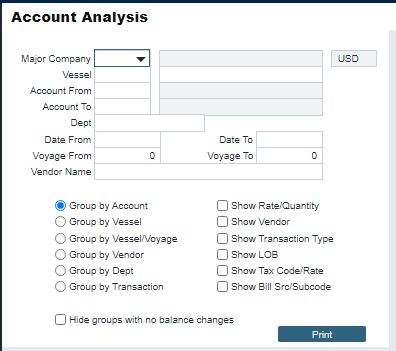
If discrepancies appear in the report, navigate to the transaction in question and confirm the following:
-
Ensure that Company is set to the correct instance.
-
Confirm that the dates range aligns with the voyage dates and the account period you want to review.
-
Confirm that the accounts selected for the report include the accounts associated with transaction.