
Home > Bunkering > Bunker Invoice
You can follow alternate bunker invoicing workflows to support different business situations. For example, you can create a Bunker Invoice before a Bunker Requirement or a Bunker Purchase has been entered, or before knowing the operational lifting quantities. If you like, you can bind the invoice to a bunker purchase or to the operational quantity at a later time. To suinpport this flexibility, there are a number of ways in which you can create a Bunker Invoice.
Creating a Bunker Invoice
-
To create a Bunker Invoice, use one of these methods:
-
On the Bunker Requirement form, right-click the selected vendor inquiry (the one with the S check box selected) and then click Create Bunker Invoice.
-
On the Voyage Bunkers form, right-click a Bunker Liftings line item and then click Create Bunker Invoice.
-
On the Voyage Invoices panel, click a Bunker Invoice card with Status: Uninvoiced.
-
On the Bunker Purchase form, click Create Bunker Invoice.
-
On the Operations menu …, under Bunkers, click Bunker Invoice.
-
Create the invoice in Financials, on the Create Bunker Invoices list.
-
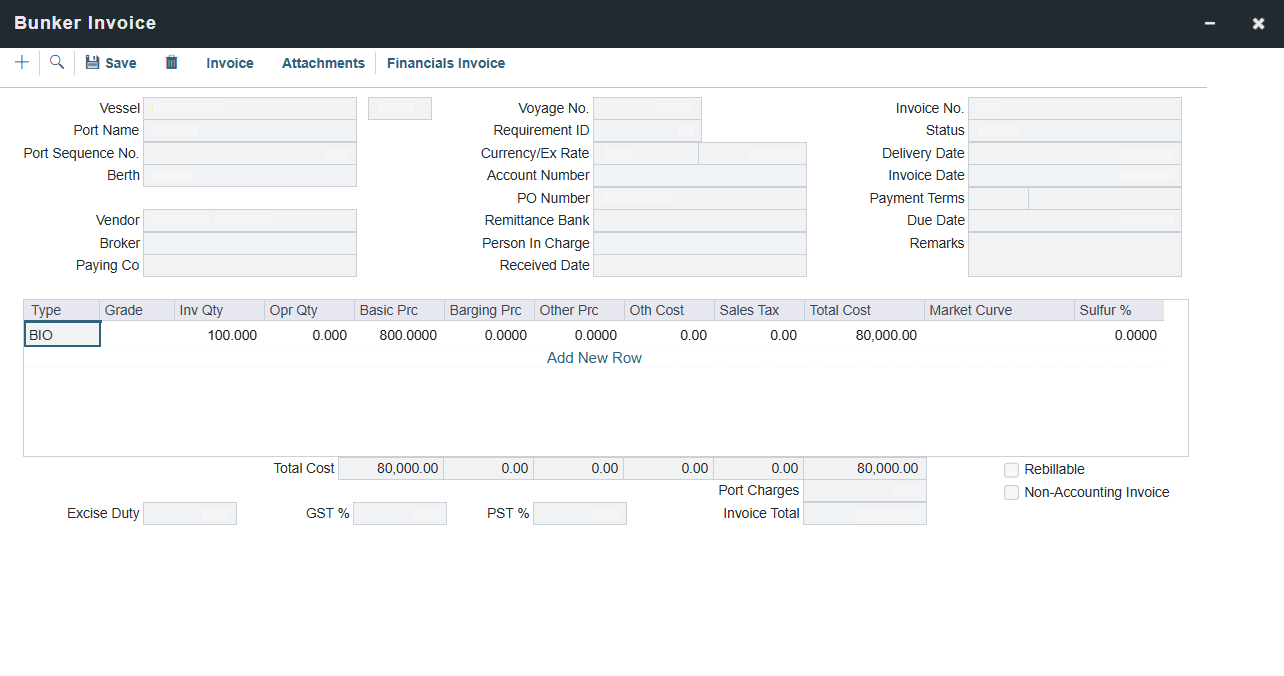
-
On the Bunker Invoice, do one of the following:
-
Complete at least the required fields.
-
If an uninvoiced Bunker Purchase matches the values when you complete fields, a selection list appears with the possible relevant Bunker Purchases. Select the appropriate one; its values populate the Invoice.
-
-
Complete any other relevant fields.
-
To approve, post, reject, export, or email an invoice, on the toolbar, click Invoice.
-
Attach documents or links or double-click to open an attachment, click Attachments. These can only be added once the Bunker Invoice has been saved with the mandatory fields.
Barging costs are included in the total cost of the bunker invoice automatically when configuration flag CFGEnableBunkerInvLumpsumFields is enabled. When it is disabled, the barging costs have to be re-entered in the invoice in order for the total costs to recalculate and include them. This flag also applies to other operations invoice forms, including Time Charter Payment, Bareboat Payment, Time Charter Bill, Freight Invoice, Claim Invoice, Demurrage/Despatch, and Voyage Other Revenues and Expenses.
The Financials Invoice link to access the Transaction Data Entry form is available in Bunker invoices when the configuration flag CFGAccessTDEFormFromOpsInvoice is enabled.
Viewing a Bunker Invoice
-
To view all Bunker Invoices, on the Transaction Summary, apply a filter to the Description column.
-
To view all Bunker Invoices related to a voyage, open its Invoices panel.
-
To view a specific Bunker Invoice, do any of the following:
-
-
On the Transaction Summary, click a row.
-
On the voyage Invoices panel, click a card.
-
On the Bunker Purchase form, click Bunker Invoice.
-
Binding a Bunker Invoice
You can create a Bunker Invoice before a Bunker Requirement or purchase has been entered and then bind the invoice to a bunker purchase later. In another case, you might create a Bunker Invoice before knowing the operational lifting quantities. Again, you can bind the invoice to the operational quantity at a later time.
If a Bunker Invoice is not bound to a Bunker Lifting, some rows in the Report Designer are empty (for example, Lifting Date GMT). Binding the Bunker Invoice to the Bunker Lifting and saving the voyage makes the values appear in the report.
Binding a Purchase to an Invoice
When you create an invoice independent of a vendor inquiry, you can later associate the invoice with the purchase.
-
On the Bunker Requirement form, right-click the selected line item and then click Bind to Bunker Invoice.
-
In the Bunker Invoice, click

-
To save the information, click

Binding a Lifting to an Invoice
When you create a Bunker Invoice before knowing the operational lifting quantities, to associate an invoice with the quantity lifted, as recorded in the Voyage Manager, follow these steps.
-
On the Voyage Bunkers form, right-click a Bunker Liftings line item and then click Bind Bunker Invoice.
-
In the Bunker Invoice, to save the information, click
Automatically Posting a Bunker Invoice
Through the use of the Messaging Service, you can automatically post Bunker Invoices once they are imported into the system. Bunker Invoices default to nonrebillable-type invoices because a Bunker Invoice would always be a transaction with a third-party vendor. If you need these to be rebillable-type invoices, you need to make a change to the XML.
If you have purchased the Messaging Service, the full Messaging Service Manual is available on request.